The Myth of the Perfect Racing Line
The perfect racing line is a useful reference, not a rule for every corner. Learn how grip, traffic, braking and the next turn change a driver’s choice.
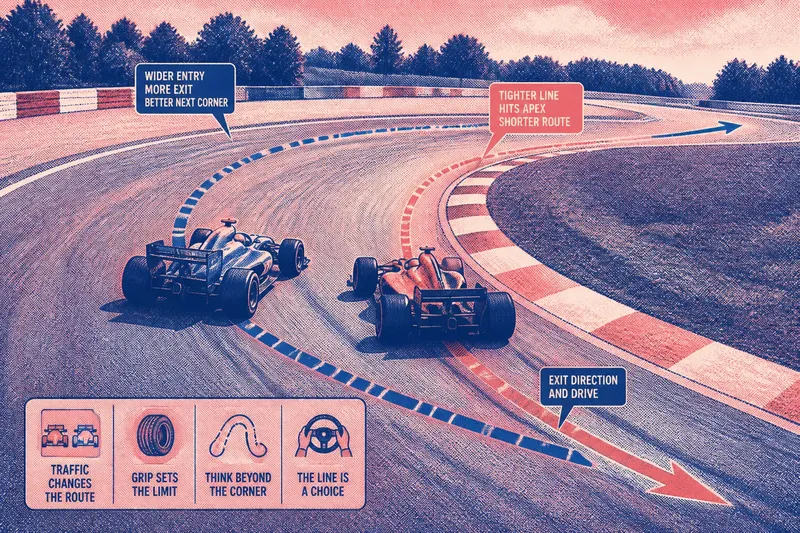
The perfect racing line is a reference, not a route every driver must follow. A racing line describes a path that can help a car carry speed through a corner, but traffic, grip, braking and the turn that follows can make another path the better choice. For spectators, that difference explains why a driver may leave the apparent ideal line without making a mistake.
Think of the line as one answer to a specific problem: how to shape a car’s path through a bend under particular conditions. Change the problem, and the useful line may change too. The driver is not tracing a drawing on the track; they are choosing where to place the car to manage speed, space and the next opportunity.
The reference line
In a simple, isolated corner, a driver often aims to enter from the outside, move toward the inside near the apex, then use the exit width. The apex is the point where the car passes closest to the inside edge of the turn. This path can open the corner’s curve and help the driver carry speed without asking the tires to turn more sharply than necessary.
That familiar outside-inside-outside shape is a useful baseline, not a law. The best path depends on the car, the corner, the surface and the priorities beyond the exit. Even a single turn can call for a different approach if the driver needs to pass, defend, avoid a bump or prepare for another bend.
A racing line also does not mean the car is always at the track’s edge. Drivers leave room for other cars and may avoid a dirty or slippery strip. Watching the path as a choice, rather than a painted target, makes those adjustments easier to read.
Grip sets the limit
Grip is the tire’s ability to transmit forces to the track. A car needs grip to slow down, turn and accelerate, and those demands overlap. If the driver asks the tires for heavy braking and strong cornering at the same time, there is less capacity available for each task. The practical result may be a wider path, a slower entry or a more cautious throttle application.
Surface conditions change the available grip. Rubber laid down on a frequently used racing line can make that strip more effective in some conditions, while dust, moisture or debris can alter the balance. The preferred route can therefore shift during a session. A driver may place a wheel away from the usual line to find a more dependable surface, though the alternative is not automatically better.
Car behavior matters as well. A car that resists turning may need a different entry and apex than one that rotates readily. A driver can adjust the path to give the car more room to settle before turning, or to avoid asking it to change direction abruptly. The visible line is an outcome of those choices, not a universal diagram imposed on every machine.
Traffic changes the route
In a race, the driver rarely has the whole corner to themselves. A car ahead can block the usual turn-in point or occupy the ideal apex. Following closely may also disturb the air reaching the car behind, reducing the steadiness the driver wants through a fast bend. The trailing driver may choose a different route to maintain control or to set up a move later.
An overtake often begins before the cars reach the corner. A driver who moves to the inside may brake later, but that position can leave a tighter path and a weaker exit. The outside route can preserve a wider arc, yet it may expose the car to a rival’s movement or leave little space at the apex. Neither side is automatically the winning line; the driver must judge whether the corner and the opponent leave room for the choice.
Defending changes the calculation too. A driver may move off the normal line to cover the inside, prompting the attacker to try the outside or delay the pass. That defensive position can compromise the defender’s route through the turn. If the attacker has a better exit, the attempted block may only change where the contest continues.
Imagine a driver approaching a medium-speed right turn with a rival alongside on the inside. The driver leaves space and takes a wider arc instead of turning toward the usual apex. The expected visible result is two cars clearing the corner without occupying the same patch of track. If the rival has to slow more sharply, the driver on the outside may emerge with room to accelerate, though the result depends on grip and available space.
Plan beyond the corner
Drivers often sacrifice speed in one corner to improve their position at the next. A slow exit onto a long straight can matter more than carrying extra speed through the preceding turn. The driver may enter more cautiously, choose a later apex and straighten the car sooner on exit. This can make the path look less direct through the first corner while serving a clear purpose afterward.
In a sequence of bends, the line through the first turn shapes the options in the next. A route that clips the first apex tightly may leave the car poorly placed for the second. Giving up that apex can let the driver position the car for a cleaner, faster path through the sequence. The spectator sees a pair of connected choices, not two isolated attempts to find the middle of each corner.
This is why the exit deserves as much attention as the apex. A driver who unwinds the steering and applies power smoothly may gain a better launch than one who reaches the apex first but has to wait before accelerating. Look at where the car points as it leaves the turn, and at whether it can use the available track without running wide.
Questions about racing lines?
Why does a driver miss the apex?
The driver may be avoiding another car, managing a slippery surface or positioning the car for a later turn. A missed apex can also follow a compromised entry, so the next part of the corner often reveals whether the deviation was deliberate.
Is the inside line always shorter?
It is generally a tighter path around the corner, but a shorter route is not necessarily the quickest way to complete the turn. The car may have to slow more and could leave the exit at a disadvantage.
Why do cars use different lines?
Drivers can face different traffic, tire grip, car balance and strategic aims at the same corner. One may be attacking while another is protecting position, so their paths reflect different problems.
What should I watch on a replay?
Compare the cars’ braking points, turn-in positions and direction at the exit rather than judging only which one touches the apex. Then watch whether either driver gains space or acceleration for the next section.
A spectator’s routine
Use a simple routine across a race weekend or broadcast. It helps separate the familiar reference line from the decisions that make each lap different.
- Before the session: Locate a corner with a clear view of entry and exit. Note which direction the track turns and where cars usually approach the apex.
- During early laps: Watch several cars pass through the same corner. Notice differences in braking, turn-in and exit position without deciding too quickly that one path is wrong.
- When traffic arrives: Follow a pair of cars into the turn. Look for a car moving off the usual line to follow, attack or leave room.
- After a position change: Check whether the driver who gained a place has a clean exit, or whether the rival can respond on the following section.
- When conditions shift: Compare later laps with earlier ones. Watch for changes in the surface, car behavior or traffic that might explain a different route.
- At the end of the race: Revisit the same corner and ask which driver’s choices worked for that situation, not which car followed a perfect line.
Keep the observation narrow: choose one corner and follow how its demands change as the race develops. That makes small decisions visible without requiring specialist timing data.
Read the line in context
The racing line remains useful because it gives spectators a reference for comparing what cars do. But the reference only becomes meaningful when paired with context: grip, car balance, traffic and the demands of the next section. A car away from the usual path may be making a smart adjustment, while a car on it may still be losing time through a poor entry or a compromised exit.
For the clearest view of the myth of the perfect racing line, watch where the driver looks to be going next. The car’s placement at one apex matters less than how that placement serves the turn, the rival and the stretch of track ahead.