Sprint Race or Grand Prix Distance? Choose by How You Watch
Sprint race or Grand Prix distance? Compare time, race flow, and viewing demands to choose the format that fits your schedule and attention.
A sprint race suits a viewer with a short window for uninterrupted action; a Grand Prix distance suits someone who wants time to watch a race develop. The difference is not simply that one is shorter. Each format gives drivers and viewers a different amount of time to respond to changing positions, tire condition, and strategy.
Choose by the kind of viewing you want: a concentrated contest with little room to settle, or a longer story in which the order can change through decisions made across the race. The best fit also depends on whether you are watching live, joining late, or learning how to read racing for the first time.
Choose by available time
If you have a brief, definite viewing window, a sprint race is usually the more practical choice. Its shorter distance compresses the contest, so the opening exchanges and every subsequent move carry a large share of the race’s story. You can often give it your full attention without arranging a long block of time.
That compression has a trade-off. A small interruption can make you miss a meaningful change, and there may be less time for a driver to recover from a poor start or a lost position. A sprint is not necessarily easier to follow just because it ends sooner; it can demand close attention while it is on.
Choose a Grand Prix distance when you can stay with the race for longer and want to see how its shape changes. The extra running time lets an early order become a starting point rather than a settled result. Drivers have more opportunity to manage a difficult phase, and teams can make decisions that alter who holds the advantage later.
If you cannot watch a full Grand Prix live, follow a defined portion instead of trying to keep every moment open in the background. The start and early running show how the field sorts itself; a later segment can reveal how the race has developed. A replay or a concise race recap can fill in missed context, if available.
Pick the format that matches the time you can actually give it, not the time you hope to have.
Choose by race flow
A sprint race tends to feel immediate because the field has less distance in which to undo an early setback. The start matters, and a driver who gains or loses ground must respond within a tighter window. This can produce a direct contest in which the viewer watches for position changes, defensive driving, and attempts to attack before the opportunity closes.
Shorter does not mean simple. A driver may have to balance pressure against the risk of losing control of the car or giving up another place. The pack can remain close, or gaps can form; the format alone does not determine how much passing occurs. It does shape how much time remains to respond when the order changes.
A Grand Prix distance makes room for a more gradual sequence. A driver may begin by holding position, then push harder as conditions or tire behavior change. A team might favor track position early, while another approach seeks a later advantage. The viewer can compare what each driver is trying to do at different stages instead of treating the opening lap as the whole contest.
Longer races also allow a race to become less predictable in its flow, not because a late reversal must happen, but because more decisions and changing conditions have time to matter. A gap that appears decisive can shrink; an early move can prove costly if it leaves a driver struggling later. Watching the direction of change is often more useful than guessing the final order.
For a compact burst of rivalry, choose the sprint. For a contest whose meaning can shift as it unfolds, choose Grand Prix distance.
Choose by viewing style
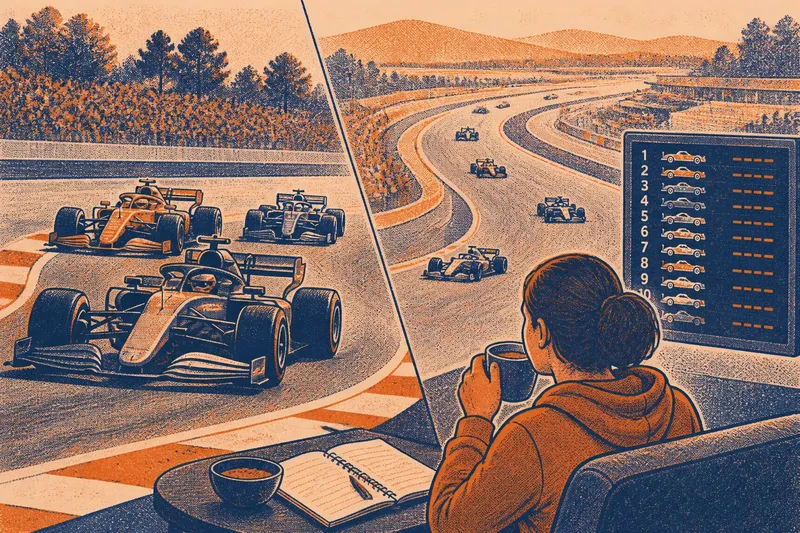
If you like to watch the pack closely, a sprint gives you a compact task: follow the start, identify the battles, and note which drivers gain or lose places. A broadcast timing tower can help. It lists competitors and their positions, while on-screen gaps show how far apart selected cars are. Check the order after a notable pass or a change in pace.
If you prefer to understand motives, a longer race offers more material. Notice whether a driver is attacking, preserving a position, or managing a phase of the race. Broadcast commentary may explain team choices, but you can also track the visible clues: a driver’s place, the gap ahead, the gap behind, and whether the same group remains together.
Imagine you can watch only one event this weekend and enjoy noticing how a contest develops. You choose the Grand Prix distance, note the running order after the opening phase, then check it again later alongside the gaps on the timing tower. If a driver who began behind has moved forward, you can ask when the change happened and what the broadcast shows about the decisions around it. The race has become a sequence you can follow, rather than a result to check at the end.
For a new viewer, either format can work. A sprint offers fewer stages to keep in mind, but its fast flow can make an interruption costly. Grand Prix distance allows more time to learn the names, positions, and rivalries, though there is more running to follow. Start with the one that fits your attention, then use the timing display to keep the order clear.
Choose by viewing situation
Use these situations to make a plain choice:
- You have a short, uninterrupted window: choose a sprint. Its concentrated action fits a focused session, with the understanding that a missed moment may matter.
- You want to watch a race unfold: choose Grand Prix distance. More time allows shifts in pace, position, and strategy to become visible.
- You are learning the basics: choose whichever event has the clearer broadcast and timing display. A sprint keeps the contest compact; a longer race gives you more chances to connect what you see with the running order.
- You enjoy immediate position battles: lean toward the sprint. The shorter format puts a premium on acting while an opening is available.
- You enjoy tracking decisions over time: choose Grand Prix distance. You can follow how a choice made earlier affects a later phase.
- You may need to step away: a sprint is easier to fit into a limited schedule, but do not assume you can return without losing context. For a longer race, decide in advance which segment you can watch and use a recap for the rest.
These are preferences, not rules. A slow sprint can still be absorbing if you like close observation, while a Grand Prix can feel lively from the opening moments. The format sets the time available; the race itself supplies the particular drama.
What changes with distance?
Does a sprint always have more passing?
No. A short race can focus attention on a small number of battles, but its length does not promise frequent overtakes. Track layout, car performance, and the positions at the start all affect what the viewer sees.
Can a Grand Prix change after the start?
Yes. The early order is only one part of a longer contest, and pace, tire behavior, and team decisions can alter the running order or the gaps. That possibility is one reason a longer race rewards watching across several phases.
Which format is easier to follow?
It depends on what makes racing clear to you. A sprint offers fewer minutes of action but a quicker stream of events; Grand Prix distance gives more context but asks for more viewing time.
Can I follow a race without watching every lap?
Yes. Track the order and gaps at the points when you watch, and use a reliable recap or replay to understand what happened between them. That approach is especially useful for a longer event, where changes may occur while you are away.
Make the choice
When deciding between sprint race and Grand Prix distance, start with the viewing experience you want. Choose a sprint for a concentrated contest and a Grand Prix for a race whose flow has room to develop. Then check the event’s schedule and broadcast details, since series may use different formats and viewing access can vary.
If you are unsure, try the format that best matches your next available stretch of attention. Watch the timing tower alongside the race, follow one or two position battles, and notice whether you want the contest to move faster or leave more room for change. That preference is a better guide to your next race than the label alone.
One useful habit carries over to either format: compare the running order at two different moments, rather than judging the entire race by its opening. It gives a short contest context and helps a long one stay legible, even when you cannot watch every lap.